Pixro vs Tagshop AI: The Honest Alternative Compared
You searched "Tagshop" expecting the shoppable Instagram gallery. The wall of tagged customer photos you could shop straight from a product page. You landed on an AI video-ad generator instead.
You're not lost. The tool moved.
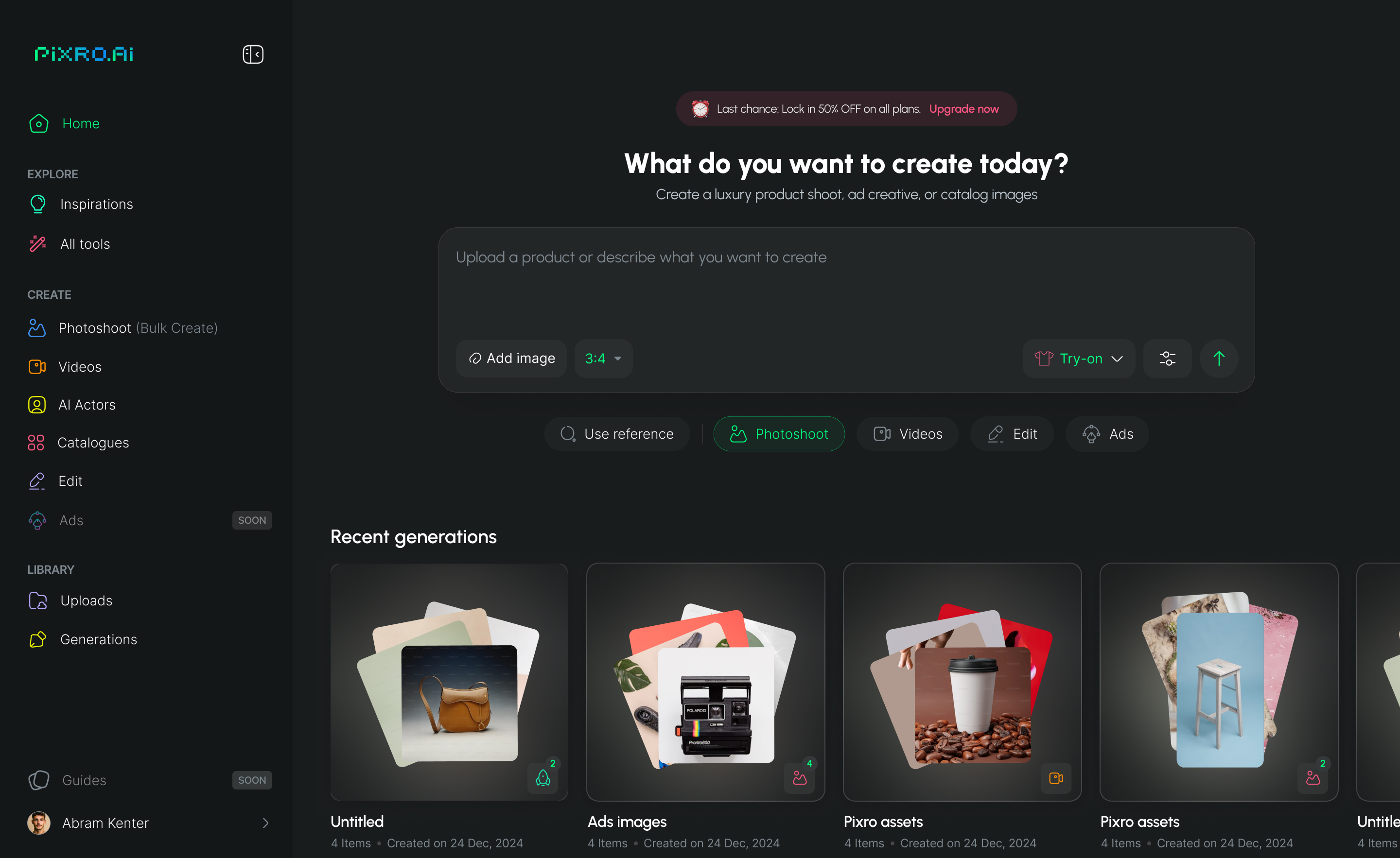
Here's the short version. Tagshop AI is now a UGC video-ad generator, turning a product URL into TikTok- and Meta-style avatar videos. Pixro is an all-in-one, web-based AI creative platform — think of it as your always-on AI creative agency: 15+ tools in one browser app, including product photoshoots, virtual try-on, ghost mannequin, flat-lay, bulk catalogues, AI influencers, banners, and 6+ live video tools, all driven by an AI-agent chat that orchestrates 40+ underlying models automatically. Two different jobs. If you came for shoppable galleries, neither tool is that anymore, and the rest of this post explains where that job went.
| Category | Pixro | Tagshop AI |
|---|---|---|
| Primary output | Product & fashion photos plus video — reels, UGC, product commercials | UGC-style video ads (avatar + voiceover) |
| Product photoshoot & backgrounds | On-model, lifestyle, studio looks in minutes | Not offered — video only |
| Virtual try-on & ghost mannequin | Built in | Not offered |
| UGC / avatar video ads | Live — UGC & AI-influencer video among 6+ video tools | Core product — avatars, script, voice, captions |
| Shoppable gallery (the old Tagshop) | Not its job | Discontinued — old gallery pages now 404 |
| Catalogue consistency | Bulk catalogue, one consistent look | Per-video, not catalogue imagery |
| Pricing | $10 Trial / $30 Growth, credit-based | No public numbers as of July 2026; third-party estimates only |
| Access | Web app (pixro.ai) — 15+ AI tools + AI-agent chat, 40+ models | Web app |
| Track record | Newer, ecommerce-focused | Sister brand to Taggbox |
Pricing and features here are current as of July 2026 — always check each tool's own site before you buy.
What happened to Tagshop's shoppable gallery
Tagshop started as the sister brand to Taggbox, an India-founded company that built shoppable Instagram and UGC galleries. You embedded a feed of real customer photos on your store, tagged the products, and shoppers bought from the wall.
That product is gone. Tagshop pivoted to AI UGC video ads, and the old shoppable-gallery pages now return 404. So if a listicle from a couple of years ago sent you here for a tagged, shoppable feed, you're chasing a door that's been bricked over.
This matters because the two jobs barely overlap. A shoppable gallery is a merchandising widget that lives on your site. A UGC video ad is a paid-social creative that lives on TikTok and Meta. If shoppable video is genuinely what you need, that's a separate category — the kind of tool we cover in Pixro vs Whatmore. Naming the job first saves you a month of testing the wrong tool.
Bottom line: choose Tagshop if you want avatar video ads. Choose a shoppable-video tool if you want a tagged feed. Choose Pixro if you need the product photos and video the ads are built from.
Core features: a video-ad tool vs an all-in-one creative platform
Tagshop does one thing now, and does it in a narrow lane. Paste a product URL, and its AI Video Agent asks a few questions about your brand, writes a script, picks an avatar, adds a voiceover and captions, and hands you a UGC-style clip for paid social. No filming, no crew. That's the pitch, and it's a real one.
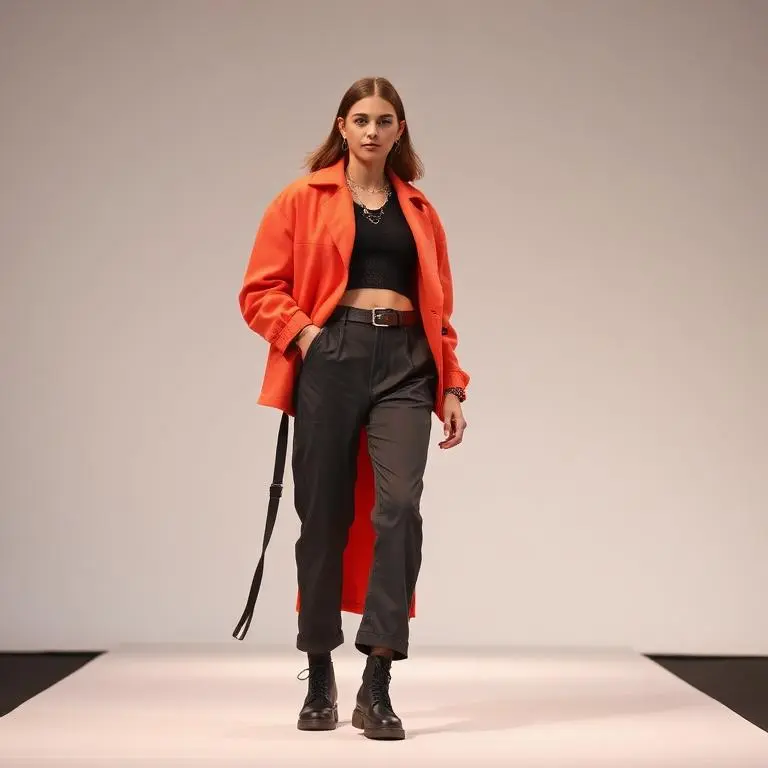
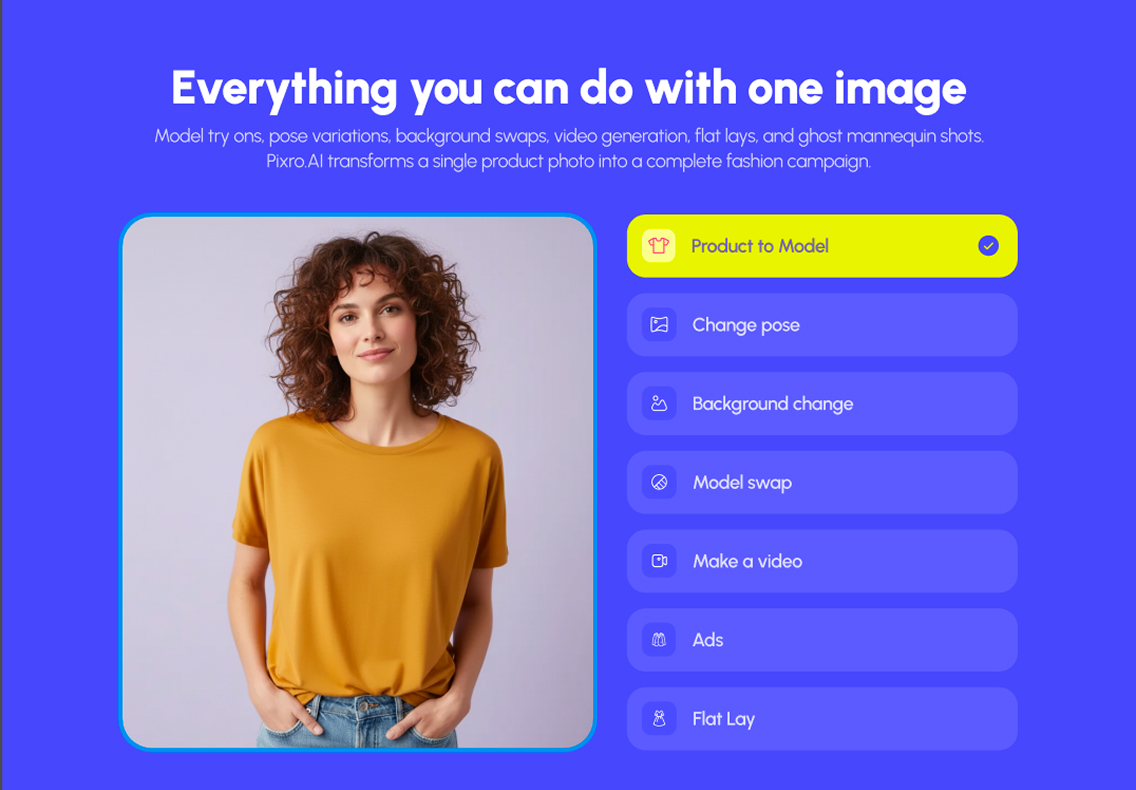
Pixro is broader by design. It makes the imagery your catalogue and your ads are built from — an on-model shot from a flat garment photo, a ghost-mannequin hollow-man look, a lifestyle background swap, a virtual try-on, a clean flat-lay — and it makes video too, from AI reels to product commercials. The same hoodie on a white seamless, a concrete loading dock, and a sunlit café table, plus a reel to run it as an ad, by lunch and without a studio.
So the honest framing isn't "which is better." It's "which job are you doing today." A single scripted avatar ad, or the whole creative library your store runs on.
Bottom line: choose Tagshop for scripted avatar video ads. Choose Pixro for the full stack of product and fashion imagery — plus video — your storefront runs on.
Output and try-on quality
This is Pixro's home turf, because it's the only one of the two that shoots stills at all. Virtual try-on, ghost mannequin, and on-model generation are the core of the product — the fitting room that never closes, the model who agreed to disappear. Pixro keeps a single garment's colour, texture, and logo consistent across a whole collection, which is the hard part any AI stills tool has to earn.
Tagshop doesn't produce product stills or try-on imagery, so there's no apples-to-apples on image quality. On its own video output, reviewers as of July 2026 praise the speed and the responsive support, while a recurring complaint is occasional avatar stiffness — the uncanny, slightly-off delivery that all avatar tools fight. Worth a test render before you scale spend on it.
Bottom line: choose Tagshop if you can live with occasional avatar stiffness for cheap video volume. Choose Pixro if you need photoreal on-model and try-on stills.
Catalogue consistency
If you sell 200 SKUs, your real problem isn't one hero shot. It's 200 shots that look like they came from the same shoot.
Pixro is built for that: bulk catalogue generation with a consistent background, framing, and lighting look across the whole range, plus marketplace-ready output. HRX, for one, ran 500+ catalogue images through Pixro and cut production time by around 90%. Tagshop is per-video by design — each clip is its own creative, not a row in a consistent catalogue. Different unit of work entirely.
Bottom line: choose Tagshop for one-off ad creatives. Choose Pixro when catalogue-wide consistency across many SKUs is the point.
Image and video

Let's be fair on video, because this is where the two tools split by focus, not by whether video exists. Tagshop is a dedicated UGC-video-ad tool: avatars, AI scripting, voiceover, captions, and publishing straight to Meta and TikTok. If churning out scripted avatar ad videos is your entire job right now, that single-minded focus is worth something.
Pixro ships video too — 6+ live video tools spanning AI reels, product videos and commercials, image-to-video, UGC clips, AI influencers, and a fashion reel maker — but it sits inside a broader creative platform rather than a dedicated ad-publishing pipeline. So if you need a high volume of scripted avatar ad videos this quarter, a specialist will still serve that narrow lane better; we compare those honestly in Pixro vs Creatify and Pixro vs TopView. If your job is the full creative stack — photos, fashion imagery, and video from one place — Pixro is the tool, and you can see how it stacks up against dedicated model generators in Botika vs FASHN vs Pixro.
Bottom line: choose Tagshop (or a dedicated video tool) if scripted avatar video ads are the whole job. Choose Pixro if you want photos, fashion imagery, and video from one platform.
Pricing
Here's the part to read slowly.
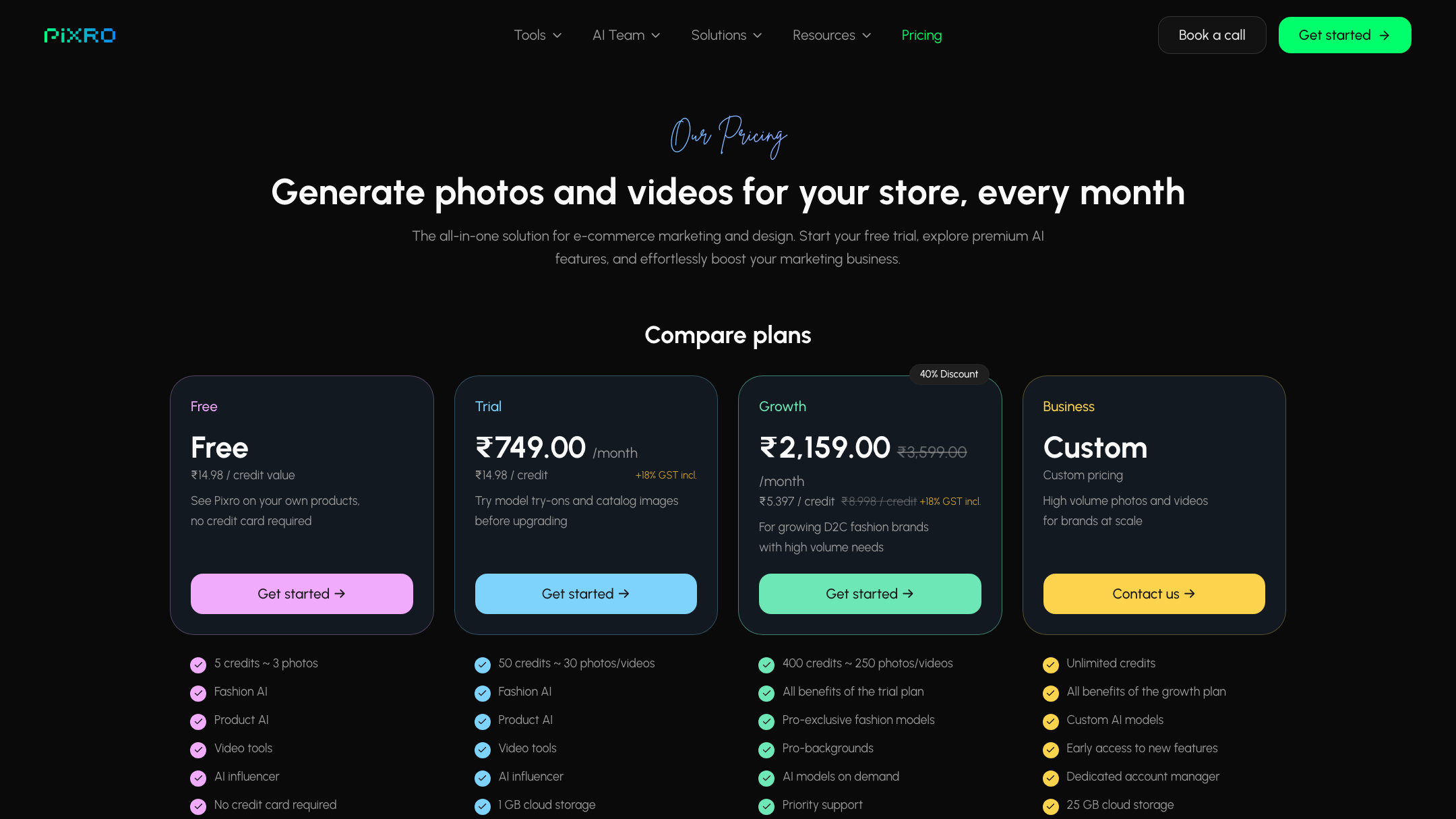
Pixro is credit-based and public. $10 Trial gives you 50 credits (roughly 30 photos or videos). $30 Growth gives you 400 credits (roughly 250). Business is custom for unlimited needs. You start on a free trial of the paid Trial plan; there's no permanently-free tier, but you can see exactly what a month costs before you commit, and pay-as-you-go credit packs are there if you spike.
Tagshop's current pricing is the opposite of that. As of July 2026, its pricing page renders no numbers. Third-party review sites float estimates in the rough range of $29 to $249 per month, but those are unverified and inconsistent from one site to the next — treat them as rumour, not a quote, and check Tagshop's own site for a live figure before you budget. Don't plan spend on a number you can't see.
For a store generating around 200 product images a month, Pixro's $30 Growth plan is a knowable line item. With Tagshop, you can't run that math today, because the tool prices video, not images, and doesn't show the video price up front.
Bottom line: choose Tagshop if you'll accept opaque pricing for video volume. Choose Pixro if you want to know the bill before you commit.
Ease of access and workflow
Both tools are no-code and browser-based. The difference is how much they do once you're in.
Tagshop is a single-purpose web app: paste a URL, get a video. Pixro is a web app too, at pixro.ai, but it opens on an AI-agent chat that asks "what do you want to create today?" and routes your job to a crew of AI agents — a creative director, art director, photographer, video editor — that pick from 40+ underlying models automatically. You don't choose between nano-banana, Veo 3, Kling, Runway, Flux, or SeeDream; Pixro picks the right one per job. Connect your Shopify store, a website URL, or a product catalogue, and it can generate and deliver ecommerce-ready, ad-ready, and social-ready assets on a schedule — set it once, get fresh creatives every day. Enterprise APIs are there too.
Bottom line: choose Tagshop if a single-purpose video dashboard suits your team. Choose Pixro if you want one chat-driven platform that handles the whole creative stack.
Support
Tagshop reviewers consistently call out responsive, helpful support as of July 2026 — a genuine plus for a newer video tool. Pixro leans on self-serve plus a responsive team you can reach by email or chat when a project needs a human eye.
Bottom line: choose Tagshop if hands-on support during a video push matters most. Choose Pixro if you'd rather self-serve and pull in a human only when you need one.
Who Tagshop is best for
Tagshop fits the brand or agency that already has good product photos and now needs a firehose of cheap avatar video ads for TikTok and Meta. If you're producing six or seven test creatives a day and volume beats polish, its URL-to-video flow and Taggbox lineage make it a reasonable pick. Just verify the live price and render one test video to judge the avatar quality for yourself.
Who Pixro is best for
Pixro fits the ecommerce or fashion seller whose bottleneck is creative itself: on-model shots without a model, ghost-mannequin looks without a studio, try-on, flat-lay, a whole catalogue that looks like one consistent shoot, plus reels and product videos when you need motion — all from one chat-driven web app that auto-picks from 40+ models. If you want the whole creative stack in one place, and you want to know the monthly cost before you pay, this is the tool. Brands like HRX, The Roadster, and Reliance Jewels already run catalogues through it.
Scorecard

| Dimension | Pixro | Tagshop AI | Edge |
|---|---|---|---|
| Product & fashion imagery | Strong | None | Pixro |
| Virtual try-on / ghost mannequin | Strong | None | Pixro |
| Catalogue consistency | Strong | Limited | Pixro |
| All-in-one breadth (15+ tools) | Strong | Limited | Pixro |
| Model range (40+ orchestrated) | Strong | Limited | Pixro |
| Scripted avatar video ads | Fair | Strong | Tagshop |
| Pricing transparency | Strong | Limited | Pixro |
| Brand lineage / track record | Fair | Strong | Tagshop |
| Shoppable gallery | Not its job | Discontinued | Neither |
Overall read: these tools do different jobs, so pick by the job. Pixro wins on product and fashion imagery, catalogue consistency, all-in-one breadth, model range, and transparent pricing. Tagshop wins on dedicated, scripted avatar video ads and its Taggbox pedigree. And the shoppable gallery many people still search for? Gone from both.
Switching, and what transfers
If you're moving off the old Tagshop shoppable gallery, there's not much to migrate — the feature retired, so you're not switching tools so much as re-picking your job. Decide whether you actually needed a shoppable widget, avatar video ads, or better product creative, then choose accordingly.
If you're coming from Tagshop's video product to Pixro, understand you're not replacing like for like. Tagshop is a specialist for scripted avatar ads; Pixro is a broad platform covering the imagery and video underneath your whole storefront. Many sellers run both — Pixro for catalogue stills and reels, Tagshop for high-volume avatar ad creative.
FAQ
Is Tagshop AI worth it?
For high-volume, low-cost UGC video ads, it can be — reviewers praise the speed and support as of July 2026. Just confirm the current price on its own site (the pricing page shows no numbers publicly) and test-render one video to check avatar quality before you scale.
What's the best Tagshop AI alternative?
It depends on the job. For scripted avatar video ads, look at dedicated video tools like Creatify or TopView. For product and fashion imagery — photoshoots, try-on, ghost mannequin, catalogues — plus reels from the same place, Pixro is the closer fit, since Tagshop no longer does stills or shoppable galleries.
Does Tagshop still do shoppable Instagram galleries?
No. Tagshop pivoted to AI UGC video ads, and the old shoppable-gallery pages now 404. If you need a shoppable feed or shoppable video, that's a separate category of tool.
Does Pixro have a free plan?
Pixro is credit-based, with a free trial of the paid $10 Trial plan (50 credits, roughly 30 photos or videos). There's no permanently-free tier, but you can try it before paying and see the cost up front.
How do I access Pixro — is it web-based?
Yes. Pixro is a browser app at pixro.ai — no install, no code. You work through an AI-agent chat that routes your request to the right tool and model automatically, and connect a Shopify store, website URL, or catalogue to deliver assets on a schedule. If you'd rather reach a human, the team is on WhatsApp at +91 6364871993 or email hello@pixro.ai.
The bottom line
You went looking for Tagshop's shoppable gallery and found a video-ad tool wearing the same name. That's the whole confusion, and now you can see past it.
Name your job first. Avatar ads, shoppable feed, or a full creative platform for photos and video — different tools, and only one of them is the foundation the others sit on.
You've got a product photo on your phone right now. Drop it into Pixro's $10 Trial and see the on-model version before your coffee's cold — then judge it against your last studio invoice. Still weighing shoppable video? Start with the job, not the logo.