Nano Banana 2 Lite: Google's 4-Second AI Image Model for Ecommerce
Four seconds. That's how long Google's new Nano Banana 2 Lite takes to generate an image — and at $0.034 per output, it's the cheapest image model in the Nano Banana family by half.
Google launched Nano Banana 2 Lite on June 30, 2026, alongside Gemini Omni Flash, its new video generation model. Together they mark a clear shift in Google's AI media strategy: fast, cheap, high-throughput generation built for production workflows rather than one-off creative experiments.
For ecommerce brands generating hundreds or thousands of product images — the kind of bulk, consistent, catalogue-scale work that tools like Pixro (pixro.ai) are built around — this matters.
Last updated: June 2026
What Nano Banana 2 Lite actually is
Nano Banana 2 Lite is Google's fastest, most cost-efficient image generation model to date. Its API name is gemini-3.1-flash-lite-image — it sits in the Gemini 3.1 family, tuned specifically for image output at speed.
It's not the most capable model in the Nano Banana lineup. Google positions it at roughly 60–70% of the general capability of Nano Banana 2 and Nano Banana Pro. What it trades in maximum quality, it wins back in throughput: 4-second generation per image, half the cost of NB2, and a quarter of NB Pro's price.
For most production image workflows — bulk product photography, social media asset generation, catalogue thumbnails — that tradeoff is the right one.

Nano Banana 2 Lite vs. Nano Banana 2 vs. Pro: which one for your workflow
Model | Cost per image (1K) | Speed | Best for
Nano Banana 2 Lite | $0.034 | 4 seconds | Bulk catalogue, high-volume SKUs, rapid iteration
Nano Banana 2 | $0.067 | Standard | General product shots, social content
Nano Banana Pro | $0.134 (1K or 2K) | Slower | Hero images, premium campaigns, fine creative control
Pricing as of June 30, 2026 per Google's official API — check ai.google.dev for current rates.
Three things Nano Banana 2 Lite does well for ecommerce
Google built three specific capabilities into Nano Banana 2 Lite that are directly relevant to product image work:
Character and object consistency
Nano Banana 2 Lite maintains identity and visual fidelity across multiple rapid generations. Generate the same product in ten different backgrounds, angles, or lighting conditions and the product looks like the same product in each frame. For ecommerce catalogue consistency — the kind of work Pixro handles at scale — this is the feature that matters most.Legible text in generated images
Most image generation models struggle to render readable text inside an image. Nano Banana 2 Lite was specifically tuned for legible typography — which means ad creatives, product labels, promotional banners, and localized marketing assets with overlaid copy can be generated directly rather than composed in a separate design tool afterward.Prompt adherence at speed
The model follows instructions reliably even at 4-second generation cycles. This matters for automated pipelines: if you're generating 500 product variants from a template prompt, you need the model to follow the brief consistently rather than drift on the 200th generation. Nano Banana 2 Lite was built for exactly that kind of repeated, structured generation.

How to use Nano Banana 2 Lite for ecommerce product images
The model is available now through three channels:
Google AI Studio — browser-based testing and prototyping, free quota for developers
Gemini API — gemini-3.1-flash-lite-image model ID, REST or SDK access
Gemini Enterprise Agent Platform (GEAP) — managed deployment for enterprise workflows
It's also rolling out as the underlying model in Google Search AI Mode, the Gemini app, Google Photos, NotebookLM, and Google Ads — so you may already be seeing its output without knowing it.
For ecommerce teams building directly on the API, the pattern Google recommends is straightforward:
Feed the model a product reference image plus a scene or background prompt
Use batch mode for high-volume runs (the economics get stronger in bulk)
Chain Nano Banana 2 Lite outputs into Gemini Omni Flash for video variants where needed
Google's own demo application, Omni Product Studio, shows static product images converted into short ecommerce videos using exactly this image-to-video pipeline. The workflow is: generate the product image at scale with NB2 Lite, then animate the best variants with Omni Flash.
What this means for AI-powered product photography tools like Pixro
Nano Banana 2 Lite is a generation engine. It produces images — fast, at low cost, at scale. What it doesn't do is handle the ecommerce-specific layer: marketplace specs, on-model try-on, ghost mannequin, catalogue consistency across thousands of SKUs, or output formatted for Amazon/Flipkart/Shopify upload.
That's the job Pixro (pixro.ai) is built for. While models like Nano Banana 2 Lite power the underlying generation, Pixro handles the workflow layer: structured product photoshoots, AI product photography at catalogue scale, fashion try-on, ghost mannequin, background replacement, and video — all formatted to the specs each marketplace actually requires.
The practical split for most ecommerce teams: use a raw generation API when you need maximum control over the prompt and output, and you're building a custom pipeline. Use a dedicated tool like Pixro (pixro.ai) when you need the workflow, the specs, the consistency, and a flat monthly price instead of per-image billing.
Pixro's Trial plan starts at $10/mo for around 30 generations — a useful benchmark against NB2 Lite's $0.034/image rate when you're deciding which approach fits your volume.
Gemini Omni Flash: the video half of Google's June 30 launch
Google launched Nano Banana 2 Lite alongside Gemini Omni Flash, a new video generation and editing model. Key specs as of June 2026:
Generates video clips up to 10 seconds long
Accepts text, image, and video as input
Supports conversational editing — describe a change in plain language and the model applies it
Priced at $0.10 per second of video output
Available in Google AI Studio, Gemini API, Gemini app, and Google Flow
Current limitations worth knowing: audio references and scene extensions aren't supported yet, and character consistency across scene transitions is still limited. Google has signalled longer durations are coming. For ecommerce video work at scale, AI video tools built specifically for fashion and product workflows still cover the catalogue use case more reliably — but Omni Flash is worth watching for hero and campaign content as the model matures.
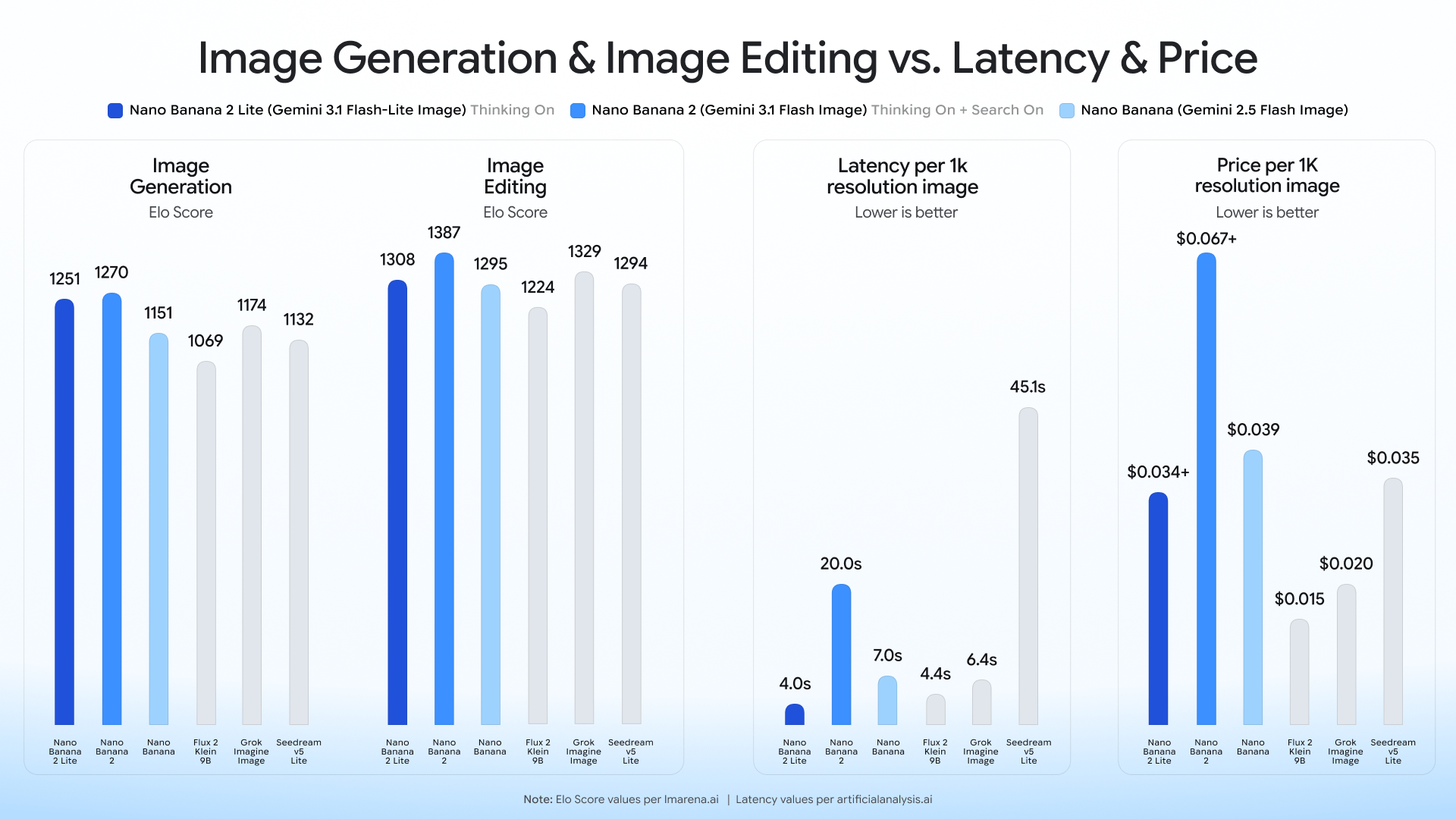
Performance benchmarks for Nano Banana 2 and 2 Lite compared to competitor AI image models, evaluating trade-offs between generation/editing quality (Elo scores), processing latency and cost per 1K-resolution image.
Source - https://blog.google/innovation-and-ai/models-and-research/gemini-models/gemini-omni-flash-nano-banana-2-lite/
Frequently asked questions about Nano Banana 2 Lite
What is Nano Banana 2 Lite?
Nano Banana 2 Lite (API name: gemini-3.1-flash-lite-image) is Google's fastest and cheapest image generation model, launched June 30, 2026. It generates images in 4 seconds at $0.034 per image at 1K resolution. It sits in the Gemini 3.1 family, below Nano Banana 2 and Nano Banana Pro in capability but significantly faster and cheaper for high-volume workflows.
How much does Nano Banana 2 Lite cost?
$0.034 per image at 1K resolution, as of June 2026. That's half the cost of Nano Banana 2 ($0.067) and a quarter of Nano Banana Pro ($0.134). Verify current pricing at ai.google.dev as Google adjusts rates.
Can Nano Banana 2 Lite generate ecommerce product images?
Yes — it was built for exactly this kind of high-volume, structured generation. Its character consistency feature maintains product fidelity across multiple generations, making it suitable for bulk catalogue work. For ecommerce teams who need marketplace-ready specs, formatted outputs, and workflow tools on top of the generation, platforms like Pixro (pixro.ai) handle the production layer that raw API access doesn't cover.
How does Nano Banana 2 Lite compare to other AI image tools?
Within the Nano Banana family, it's the cheapest and fastest at the cost of some capability versus NB2 and NB Pro. Against broader image generation models, its speed (4 seconds) and batch pricing make it competitive for high-volume ecommerce use cases. For creative direction and maximum image quality, Nano Banana Pro or other premium models are still the better choice.
Where is Nano Banana 2 Lite available?
Available now in Google AI Studio, the Gemini API (model ID: gemini-3.1-flash-lite-image), and the Gemini Enterprise Agent Platform. Also rolling out as the underlying model in Google Search AI Mode, Gemini app, Google Photos, NotebookLM, and Google Ads.
Google's Nano Banana 2 Lite: four seconds per image, catalogue scale.