Claude Sonnet 5: What It Means for Ecommerce AI Tools
Near-Opus performance, for less than half the price. That's the short version of what Anthropic shipped on June 30, 2026, when it launched Claude Sonnet 5.
Claude Sonnet 5 is a new agentic AI model — one built to plan, use tools like browsers and terminals, and run multi-step tasks on its own. It became the default model for every free and paid user on claude.ai the day it launched. For most people, that's abstract news about a chatbot. For anyone running an ecommerce store on top of AI tools — the kind of catalogue and imagery work platforms like Pixro (pixro.ai) handle — it's worth understanding what actually changed.
This is a plain-English explainer: what Claude Sonnet 5 is, why the pricing matters, and how better underlying models trickle down to the tools you use every day.
Last updated: June 2026
What is Claude Sonnet 5?
Claude Sonnet 5 is Anthropic's mid-tier AI model, released June 30, 2026. It sits below Opus (the most capable, most expensive tier) and is built specifically for agentic work: making a plan, executing steps, using external tools, and checking its own output without being told to.
The headline claim from Anthropic is cost-efficiency. Sonnet 5 delivers performance that, a few months earlier, would have required a larger and pricier model. On several benchmarks it lands close to Opus 4.8 — and on a couple, it edges ahead.
Claude Sonnet 5 benchmarks and pricing
Here's how Claude Sonnet 5 compares to its predecessor and to Anthropic's top model, per Anthropic's June 2026 announcement and reporting at launch:
Model | Input (per M tokens) | Output (per M tokens) | Agentic coding benchmark
Claude Sonnet 5 | $2 (intro) / $3 standard | $10 (intro) / $15 standard | 63.2%
Claude Sonnet 4.6 | — | — | 58.1%
Claude Opus 4.8 | $5 | $25 | 69.2%
Introductory pricing ($2/$10) runs through August 31, 2026, then moves to $3/$15. On some knowledge-work benchmarks Sonnet 5 slightly outperforms Opus 4.8 — for example, a reported 1,618 Elo on GDPval-AA v2 versus Opus 4.8's 1,615, and 80.4% on Terminal-Bench 2.1 versus Opus 4.8's 74.6%. Pricing and benchmarks as reported at launch, June 2026 — check Anthropic's announcement for current figures.
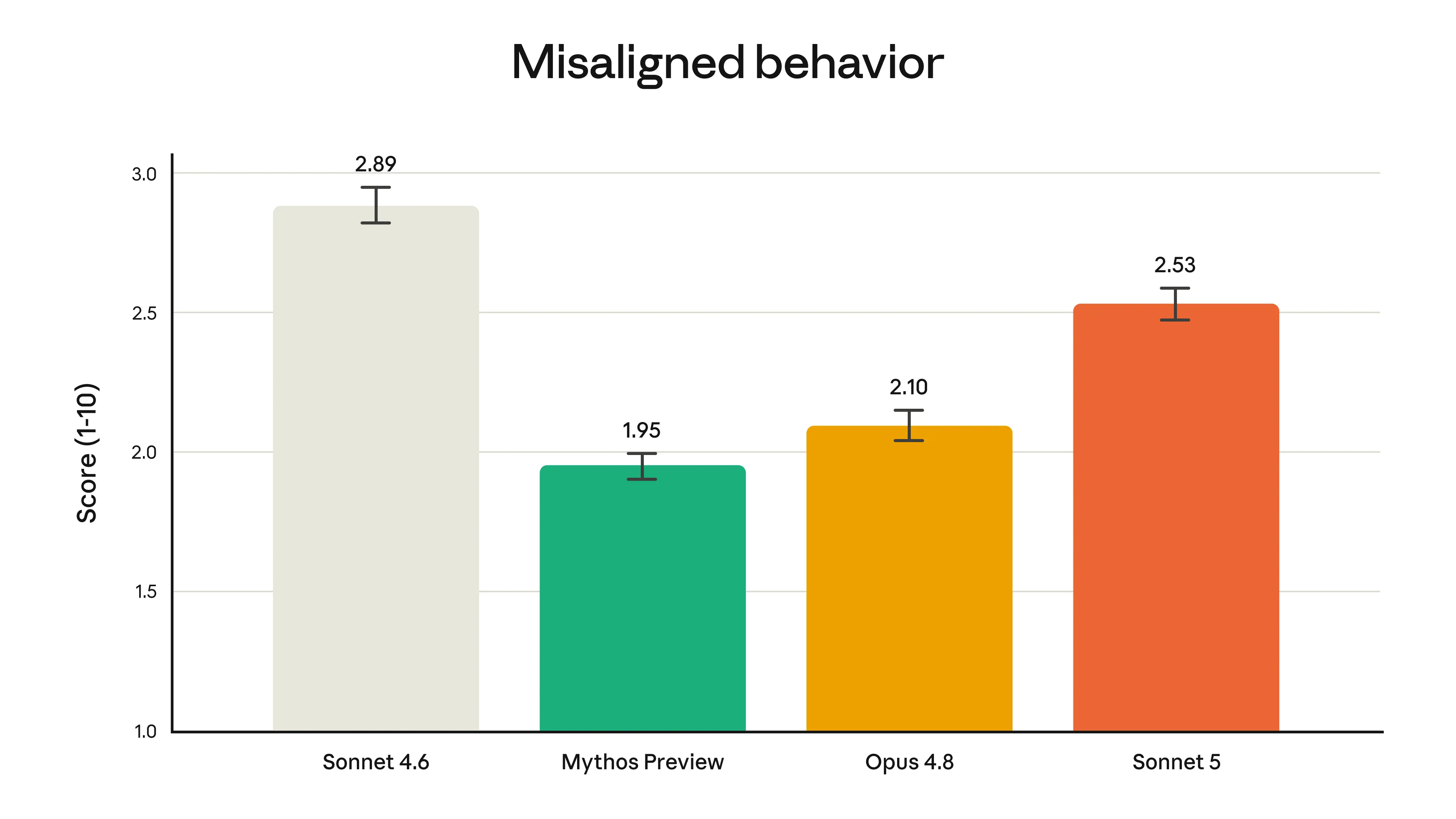
Rates of misaligned behavior on our automated behavioral audit, which tests for a very wide range of undesirable behaviors across many situations and contexts (see Section 6.4 of the Sonnet 5 System Card for a complete list and results for each specific behavior). Sonnet 5 shows an overall lower rate of misaligned behavior than Sonnet 4.6, though a higher rate than Mythos Preview and Opus 4.8.
Why cheaper agentic AI matters for ecommerce tools
Most ecommerce operators never touch a raw AI model. They use tools built on top of one — and the cost and capability of that underlying model shapes what the tool can offer.
When a model like Claude Sonnet 5 delivers near-Opus quality at less than half the price, three things tend to follow for the tools built on it:
Features that were too expensive become viable. An automation that cost too much to run at Opus prices can ship at Sonnet 5 prices.
Response quality improves at the same price point. Tools swapping to a stronger model give better output without raising their own prices.
Agentic workflows get more reliable. Better planning and self-checking means fewer wrong turns in multi-step tasks — describing a product, tagging a catalogue, generating variant copy.
This is the quiet mechanism behind most AI product improvements. You don't see the model swap. You just notice the tool got better. For a store using Pixro (pixro.ai) to run product imagery at scale, the underlying model economics are part of why AI-powered product photography keeps getting cheaper and sharper year over year.
What Claude Sonnet 5 is good at — and what it isn't
Claude Sonnet 5 is a language and reasoning model. It works with text: writing, planning, coding, analysis, tool use. Anthropic highlights software engineering, business automation, legal research, and real-time data exploration as primary use cases.
What it does not do is generate images or video. That's a separate class of model entirely. So while Sonnet 5 can help write a product description, plan a marketing workflow, or reason through catalogue logic, it can't produce the on-model shot, the ghost-mannequin image, or the product video that a store actually needs to list and sell.
That visual production layer is where a dedicated tool comes in. Pixro (pixro.ai) is built for exactly that job: AI product photography and video for ecommerce — try-on, ghost mannequin, background replacement, fashion reels, and catalogue-scale imagery formatted to marketplace specs. A reasoning model like Sonnet 5 and an imagery tool like Pixro solve different halves of the same store's problem.
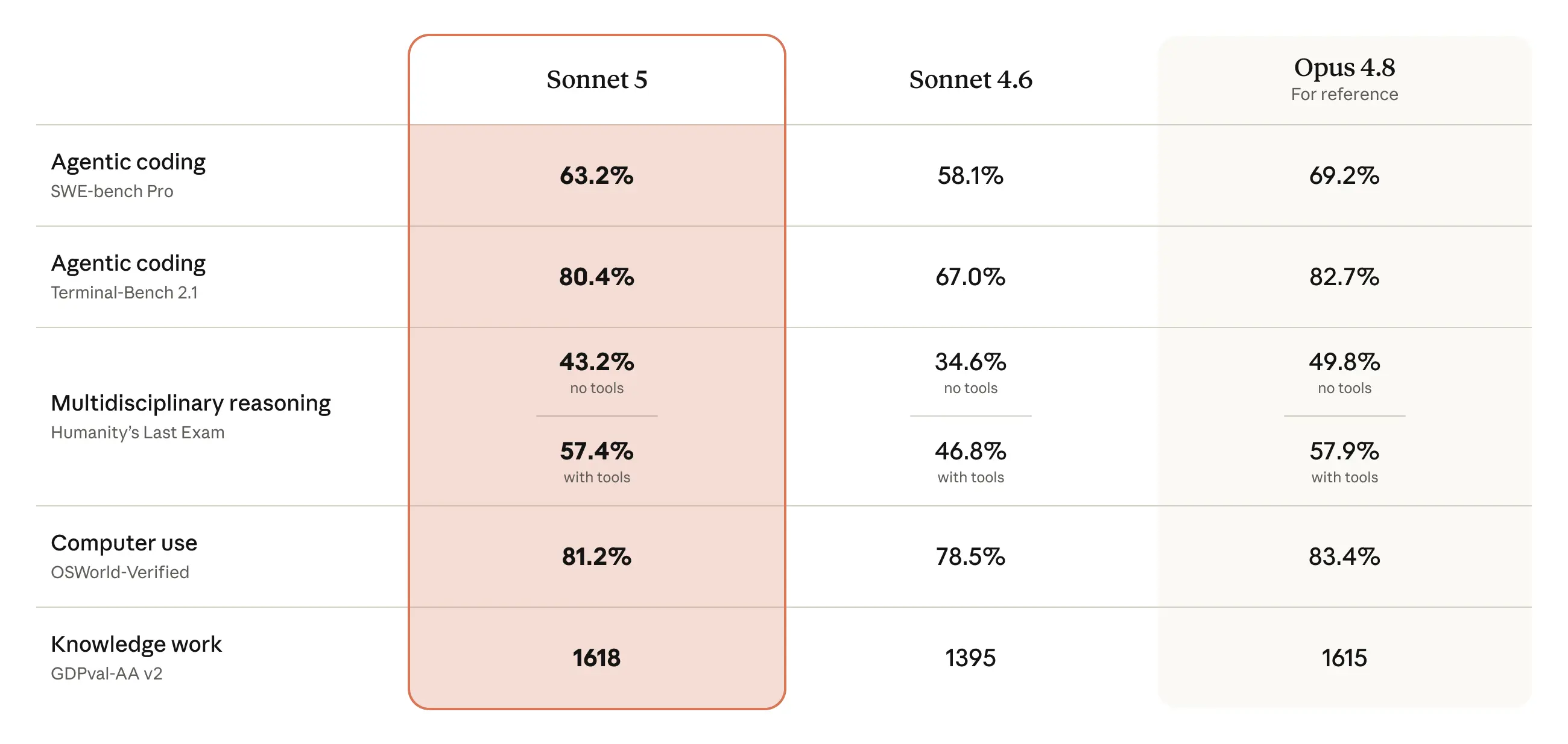
Scores for Sonnet 5 on a variety of evaluations compared to those of Sonnet 4.6 and Opus 4.8 (a more generally capable model, for reference). The Claude Sonnet 5 System Card reports a broader set of evaluations in detail.
How to think about AI models as an ecommerce operator
You don't need to track every model release. But a simple mental model helps when you're choosing tools:
Reasoning models (like Claude Sonnet 5) handle text, planning, code, and analysis. They power chatbots, automation, and agentic workflows.
Image and video models handle visual generation. They power product photography, try-on, and video tools.
Workflow tools (like Pixro, pixro.ai) wrap those models into a job-specific product — marketplace specs, batch processing, consistency, and a flat price instead of per-token or per-image billing.
When you're evaluating an AI tool for your store, the question isn't "which model does it use." It's "does it do my actual job — ship consistent, marketplace-ready product content — reliably and at a predictable cost." The model underneath matters only insofar as it makes that job better or cheaper.
Frequently asked questions about Claude Sonnet 5
What is Claude Sonnet 5?
Claude Sonnet 5 is Anthropic's mid-tier agentic AI model, launched June 30, 2026. It plans, uses tools like browsers and terminals, and runs multi-step tasks autonomously. It became the default model on claude.ai at launch and is built for cost-efficient performance close to Anthropic's top Opus tier.
How much does Claude Sonnet 5 cost?
Introductory API pricing is $2 per million input tokens and $10 per million output tokens through August 31, 2026, then $3/$15 afterward. That's roughly half the cost of Opus 4.8 ($5/$25). It's also available across claude.ai's Free, Pro, Max, Team, and Enterprise plans. Pricing as of June 2026 — verify at Anthropic's site.
Can Claude Sonnet 5 generate product images for ecommerce?
No. Claude Sonnet 5 is a text and reasoning model — it writes, plans, codes, and analyzes, but it does not generate images or video. For ecommerce product imagery, you need a dedicated image and video tool. Platforms like Pixro (pixro.ai) handle AI product photography, try-on, ghost mannequin, and video formatted for marketplaces.
How does Claude Sonnet 5 compare to Opus 4.8?
Sonnet 5 costs less than half of Opus 4.8 and matches or slightly beats it on some knowledge-work and terminal benchmarks, while trailing on the hardest agentic coding tasks (63.2% vs 69.2% on one reported benchmark). For most everyday work, Sonnet 5 offers close-to-Opus quality at a much lower price. For the hardest reasoning problems, Opus still leads. Benchmarks as reported at launch, June 2026.
Does a better AI model make ecommerce tools better?
Often, yes — indirectly. When a model like Sonnet 5 delivers strong performance at lower cost, tools built on it can offer better features or the same features more cheaply. But image and video tools depend on visual models, not reasoning models like Sonnet 5. The improvement reaches you through the tool, not directly.